
Soil: The Power Beneath Our Feet
Why Soil Life Is the Real Hero of the Garden
If you’ve ever wondered why some gardens look vibrant and effortless with lush roses, happy herbs, thriving shrubs—the secret isn’t magic, luck, or expensive products. It’s the soil. More specifically: living soil.
Beneath every healthy plant is an entire hidden community of tiny workers, bacteria, fungi, earthworms, and countless microscopic organisms teaming up to build strong roots, deliver nutrients, and hold moisture right where plants need it. When we garden organically, we’re not just feeding plants, we’re feeding the whole underground community that supports them.
Beneath every healthy plant is an entire hidden community of tiny workers, bacteria, fungi, earthworms, and countless microscopic organisms teaming up to build strong roots, deliver nutrients, and hold moisture right where plants need it. When we garden organically, we’re not just feeding plants, we’re feeding the whole underground community that supports them.
Fertilizers: Organic vs. Synthetic
Think of organic fertilizers like a homemade stew: real ingredients, natural nutrients, and a slow simmer that brings out the best flavors. Organic fertilizers need soil organisms to “cook down” the ingredients into a form plants can use. As those organisms munch, they improve soil texture, boost fertility, and help roots grow deeper and stronger. It’s slow‑release, steady, sustainable growth. Plants don’t “gulp” nutrients; they sip and savor them.
Synthetic fertilizers, on the other hand, act more like energy drinks—instant, potent, and easy for plants to absorb right away. But they’re also salty and concentrated, which means:
Think of organic fertilizers like a homemade stew: real ingredients, natural nutrients, and a slow simmer that brings out the best flavors. Organic fertilizers need soil organisms to “cook down” the ingredients into a form plants can use. As those organisms munch, they improve soil texture, boost fertility, and help roots grow deeper and stronger. It’s slow‑release, steady, sustainable growth. Plants don’t “gulp” nutrients; they sip and savor them.
Synthetic fertilizers, on the other hand, act more like energy drinks—instant, potent, and easy for plants to absorb right away. But they’re also salty and concentrated, which means:
- Plants need regular watering to avoid salt burn
- Growth can be fast, soft, and water‑hungry
- Soil life doesn’t get fed and may even get stressed
Quick results, yes. Long-term soil health? Not so much.
How Organics Help Plants Use Less Water
This surprises many homeowners, but it makes perfect sense once you see how the soil system works:
How Organics Help Plants Use Less Water
This surprises many homeowners, but it makes perfect sense once you see how the soil system works:
- Less salt → water stays in the root zone instead of being pulled away
- Better soil structure → more humus, which acts like a sponge
- Slower, more natural growth → sturdier plants that need less water
- Mycorrhizae help roots drink more efficiently (more on that below!)
Organic gardens simply hold onto water better—and use it more wisely.
Mycorrhizae
Mycorrhizae
Mycorrhizae are special fungi that connect to plant roots and act like an extension of the root system. They build a vast underground network that expands the root’s reach, scouts for water and nutrients, trades resources with other plants, and helps plants handle stress, drought, and heat.
Understanding Soil pH
Soil pH simply tells you whether your soil is more acidic or alkaline. Most garden plants love a range between 5.5 and 7, where nutrients are easiest to absorb.
Soil pH simply tells you whether your soil is more acidic or alkaline. Most garden plants love a range between 5.5 and 7, where nutrients are easiest to absorb.
- If your pH is too high (alkaline), add E.B. Stone™ Naturals Sul‑Po‑Mag.
- If your pH is too low (acidic), add E.B. Stone™ Naturals Agricultural Lime.
Soil Texture
Is your soil texture sandy, silty, or clay? Your soil is a mix of sand, silt, and clay—and that mix affects how quickly water drains:
Is your soil texture sandy, silty, or clay? Your soil is a mix of sand, silt, and clay—and that mix affects how quickly water drains:
- Sandy Soil: Drains super-fast
- Silty Soil: Moderate
- Clay Soil: Holds onto water tightly
Whatever you have, adding organic matter consistently improves it by creating airy pockets, moisture-holding humus, and better pathways for roots and soil life.
Soil Amendments
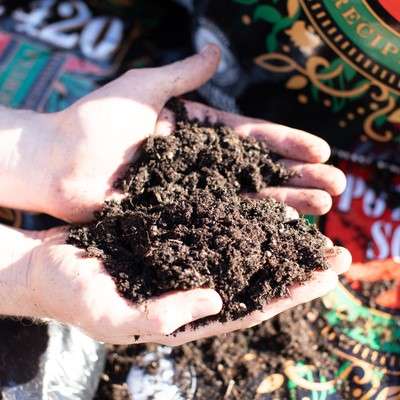
Organic matter is simply plant and animal material in various stages of decay. When it finishes breaking down into a dark, soft, earthy-smelling material, we call it humus. Humus feeds soil life, holds water, improves structure, and helps plants absorb nutrients with ease.
Organic matter is simply plant and animal material in various stages of decay. When it finishes breaking down into a dark, soft, earthy-smelling material, we call it humus. Humus feeds soil life, holds water, improves structure, and helps plants absorb nutrients with ease.
Mulching
Mulching is the simplest, most powerful habit any gardener can adopt. A 2"-3" layer of wood chips, straw, or compost: slows moisture loss, keeps soil evenly cool, suppresses thirsty weeds, and breaks down into more humus.
Mulching is the simplest, most powerful habit any gardener can adopt. A 2"-3" layer of wood chips, straw, or compost: slows moisture loss, keeps soil evenly cool, suppresses thirsty weeds, and breaks down into more humus.